
NYSTCE Passing Scores Explained
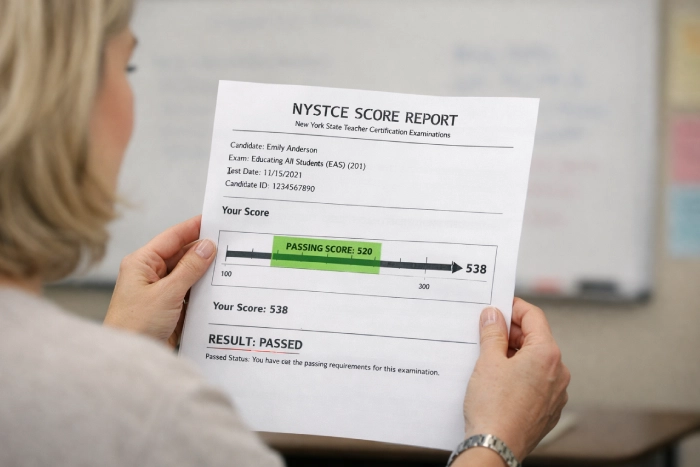
The different exams and scales used to measure NYSTCE passing scores can make it confusing for candidates. If you get your score report, you will find references to the scaled score, Safety-Net Requirement, and competency performance. On the surface, these may appear to be challenging to comprehend.
This is an overview of the NYSTCE passing score explained. It addresses the scoring scales, how you will get your total score, how to interpret your score report, and what happens when you don’t pass. For those studying for exams and/or planning on retaking, there are also other resources for preparation at New York Exam Help.
Keep in mind that the NYSTCE policies can change. It is always important to verify with the most recent scoring guide of the score report for your exam.
NYSTCE Uses Two Different Scoring Scales
There’s one of the biggest reasons why candidates are confused is that the scoring scale for each of the NYSTCE exams is different. The passing scale for most NYSTCE examinations, such as the NYSTCE CST passing score and NYSTCE EAS passing score, ranges between 400 and 600 scaled scores. The passing grade for these tests is 520.
Calculating the 100–300 scale is different for some NYSTCE exams. The scaled scores for these tests are typically a pass mark of 220. Do NOT compare test scores across tests as they are on different scales. The exam score of one exam may not be suitable for another.
Always check the necessary passing grade for your test on the official test preparation material and score sheets before you take your exam. The NYSTCE Exam Pass Rates 2026 guide is also helpful for understanding the average pass rates of candidates taken in various tests.
How Your Total Score Is Calculated
Many candidates are enquiring about the NYSTCE scaled score meaning, which is displayed on their report. The scaled score does not equal the number of questions answered correctly. Rather, it is your performance in the overall testing system, as that performance is translated into the reporting scale for your examination.
Your overall score is a combination of the performance in both components of the examination:
- Selected-response (multiple-choice) questions
- Constructed-response assignments, if incorporated
Selected-response questions make up about 80% of the total grade for most CST one-subject exams, and constructed-response assignments make up about 20% of the total grade for most one-subject exams.
The constructed-response section typically accounts for approximately 30% of the final score for the Literacy/English Language Arts subtest, as part of multi-Subject examinations.
No marks are deducted for wrong answers. Each selected response question is equally weighted, meaning that leaving them blank will not help you to get additional points. When you don’t know the answer, guessing is the best approach.
Performance indicators for competencies or subareas may also be included on your score report. These indicators are not passing criteria, but rather they are for the identification of strengths and weaknesses. Your pass or failure in the examination is based solely on your scaled score.
Understanding the Safety-Net Requirement
One of the most confusing aspects of NYSTCE scoring is its NYSTCE safety-net requirement.
The Safety-Net Requirement is a temporary measure to help some candidates get a passing grade when their scaled score is marginally lower than the standard passing scaled score.
For instance, the passing grade on the Educating All Students (EAS) exam is 520. The Safety-Net Requirement will allow candidates to still be awarded a “Pass” status if they achieve a score of 500 or higher.
This is a temporary provision that may be updated by policy, and candidates should always make sure that this applies to the examination and testing administration of which they are a part before relying on it.
How to Read Your Score Report
Once you become familiar with how to read the NYSTCE score report, reading the information becomes a lot easier. Your final score and your overall scaled score are listed on your score report. Based on your work, your status will be “Pass” or “Did Not Pass. This is based on the passing grade (or the applicable Safety-Net Requirement, if there is one) for your exam.
The Report also contains competency performance indicators. The symbols are used as follows: “+” is for very poor performance, “++++” is for very good performance. Pass or fail is not based on these symbols. Rather, they assist you in pinpointing which topics you did well and which ones you need to work on more to pass a retake.
Several candidates may find that there is a star next to their score. Typically, the score is within 0.5 standard error of measurement (SEM) of the passing score. In a few cases, this might mean that a NYSTCE score waiver may be possible. Requirements may vary; please check the most up-to-date guidance on certification before applying.
What Happens If You Don’t Pass?
The resounding question that candidates often ask is what happens if you fail the NYSTCE? If you do not get a passing score, you will not lose your way to certification, but you will not get a passing score.
No specific number of times one can take an NYSTCE examination. There is a 60-day waiting period; however, you still have to register for the same exam again.
If there is a possibility that you will be eligible for a NYSTCE score waiver, check the official NYSTCE score waiver requirements before scheduling another attempt. In some cases, it may be possible to obtain a waiver; this is an alternative to taking the examination as soon as possible.
Once you are ready for your next exam, the NYSTCE Registration Guide 2026 provides information on the registration process, testing requirements, important deadlines and fees.
Tips to Reach (or exceed) the Passing Score
One of the best study tools at your disposal is your score report. Rather than going over each topic once again, concentrate on the areas of competency where your performance indicators were the lowest.
Spend time getting used to the actual test. Practising with timed tests enhances confidence and time management ahead of the test.
If you are not able to make progress on the same subjects, then you might want to try more structured preparation resources. Here are the best study resources for New York teaching certification exams that can help you figure out what makes a good study resource.
Establishing good study routines also has an impact. The article Study Habits That Help Students Improve Academic Performance provides practical tips for creating a more effective study habit.
Conclusion
Once you understand the NYSTCE passing scores and how your scores are reported, it’s much easier to understand the passing scores. Regardless of the scale your test is based on (400-600 or 100-300), the same steps apply: Pay attention to your overall scaled score; look at how you did on your competency scales; and factor in the feedback to get better going forward.
If you didn’t pass this time, keep in mind that lots of successful teachers needed to try a second time. If you need to prepare for the next time you take the test, make a plan with your score report; if you need to know the most up-to-date NYSTCE policies for your exam, check with your score report; and, if you are to take the test again, you can use your score report to let you know. Passing the NYSTCE is attainable with diligence and proper study tools.
FAQ
Q: What is the passing score for the NYSTCE EAS?
A: The standard passing score for the EAS is 520 on a 400-600 scale, though the Safety-Net Requirement can allow a score of 500 or higher to still be reported as a Pass.
Q: Do all NYSTCE exams use the same passing score?
A: No, most tests use a 400-600 scale with a passing score of 520, while some use a 100-300 scale with a passing score of 220 — always check the specific requirement for your exact exam.
Q: Does the constructed-response section count toward my total NYSTCE score?
A: Yes, your total score combines your selected-response results with your constructed-response score, with the constructed-response portion commonly weighted around 20-30% depending on the specific test.
Q: How many times can I retake the NYSTCE if I don’t pass?
A: You can retake a NYSTCE exam as many times as needed until you pass, though a mandatory 60-day waiting period applies between attempts on the same test.
Q: What does the asterisk next to my NYSTCE score mean?
A: It indicates your score fell within 0.5 standard error of measurement (SEM) of the passing score, which may make you eligible to apply for a certification exam score waiver instead of retaking the test.